AI-Proof Your Career
What I told Augsburg University business students about building a career in the age of AI, from two seats: the person who hires software engineers, and the person who has taught graduate AI for over a decade.
By Justin Grammens
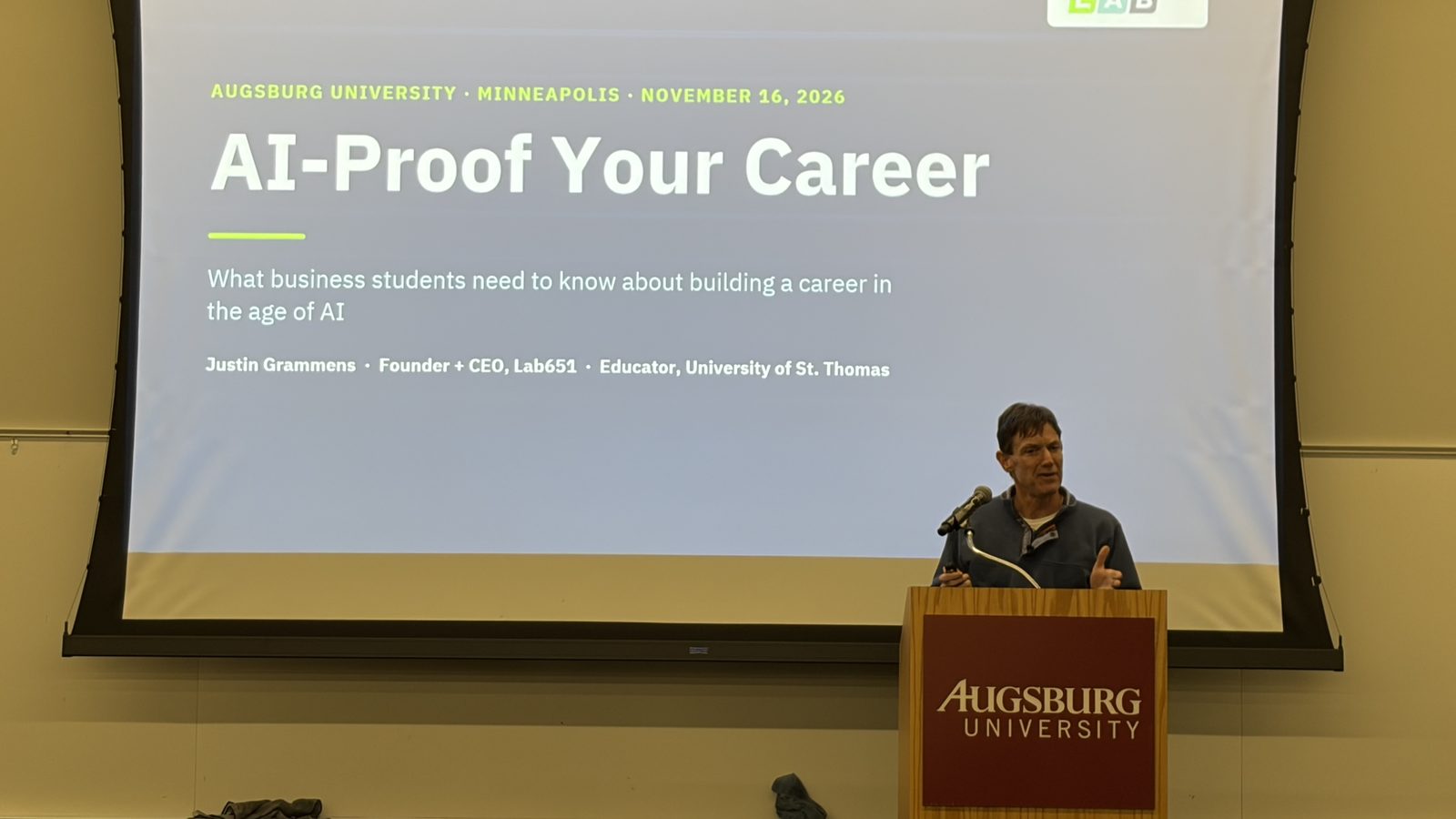
On November 16, I spoke at Augsburg University’s Innovator Speaker Series to a room of business and MBA students. The title was “AI-Proof Your Career,” and it was a homecoming of sorts. I went to Augsburg, applied math major and physics minor, and I wish more people doing the work had come in to speak when I was sitting where they were. Talking with people who are just starting out is one of my favorite ways to give back, and it keeps me honest about what the job market actually looks like.
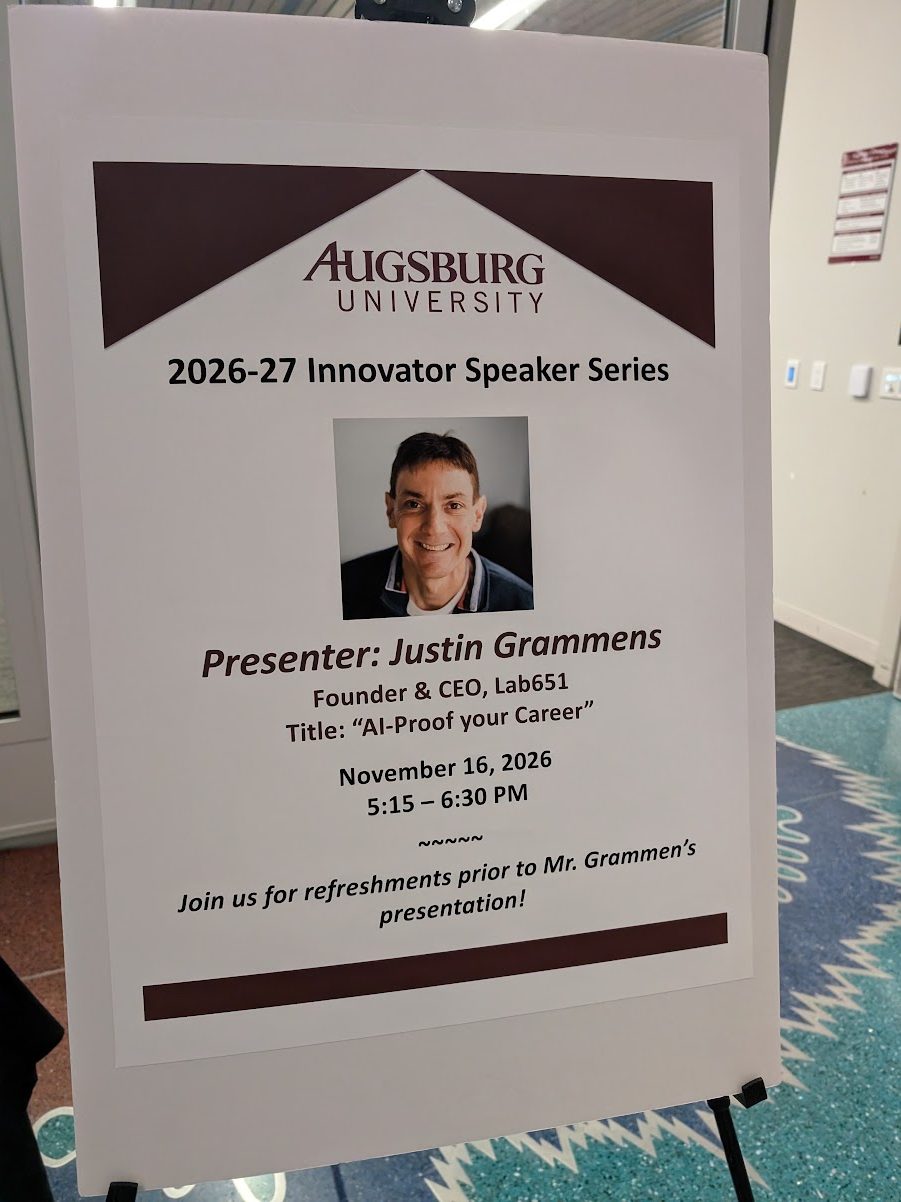
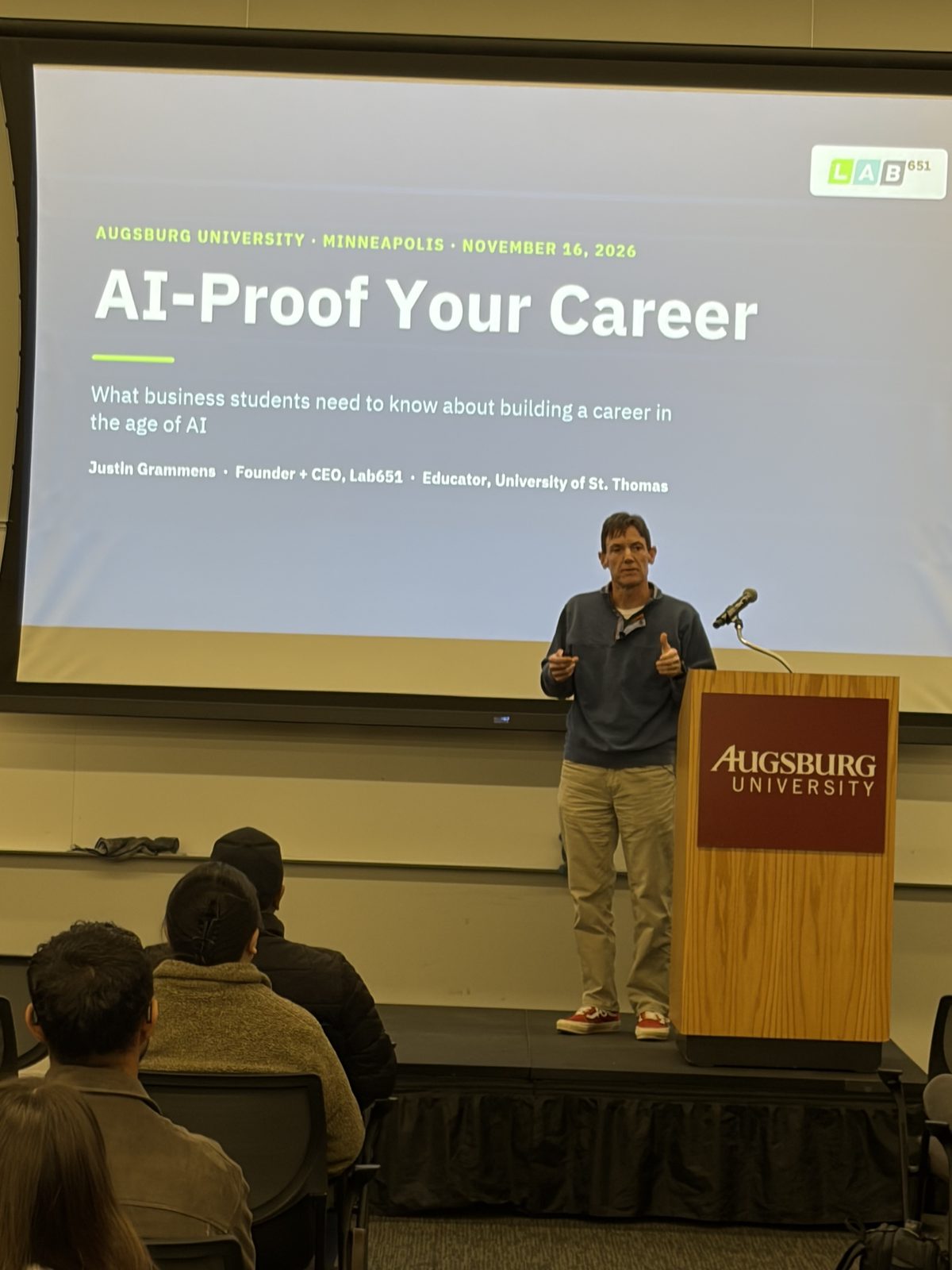
The full slide deck is free on GitHub as a PDF.
I opened with a show of hands. Who used AI this week? Nearly everyone. Who used it today? Most of the room. Keep your hand up if your boss knows how you use it. Most hands went down. That gap is what the talk was about.
I see this from two sides of the same table. At Lab651, I hire software engineers to build custom software and AI for medical device, healthcare, insurance, financial services and retail companies, where mistakes are expensive. At the University of St. Thomas, I’ve taught graduate AI and machine learning for over a decade, and every semester I watch new professionals walk into this job market. From both seats, the people thriving aren’t the most technical. They moved first.
The entry-level job just changed
Entry-level work used to be first drafts, research, summaries and the repetitive middle of every project. That is how juniors earned their stripes, and AI now does it first.
The new entry-level job looks different. A junior pairs with a senior on real work, brings AI in as a third teammate, and learns what to keep and what to throw away from what it returns. Evaluating AI’s work is the new junior job. The tasks moved to AI. The judgment was always yours, and now it’s the whole job.
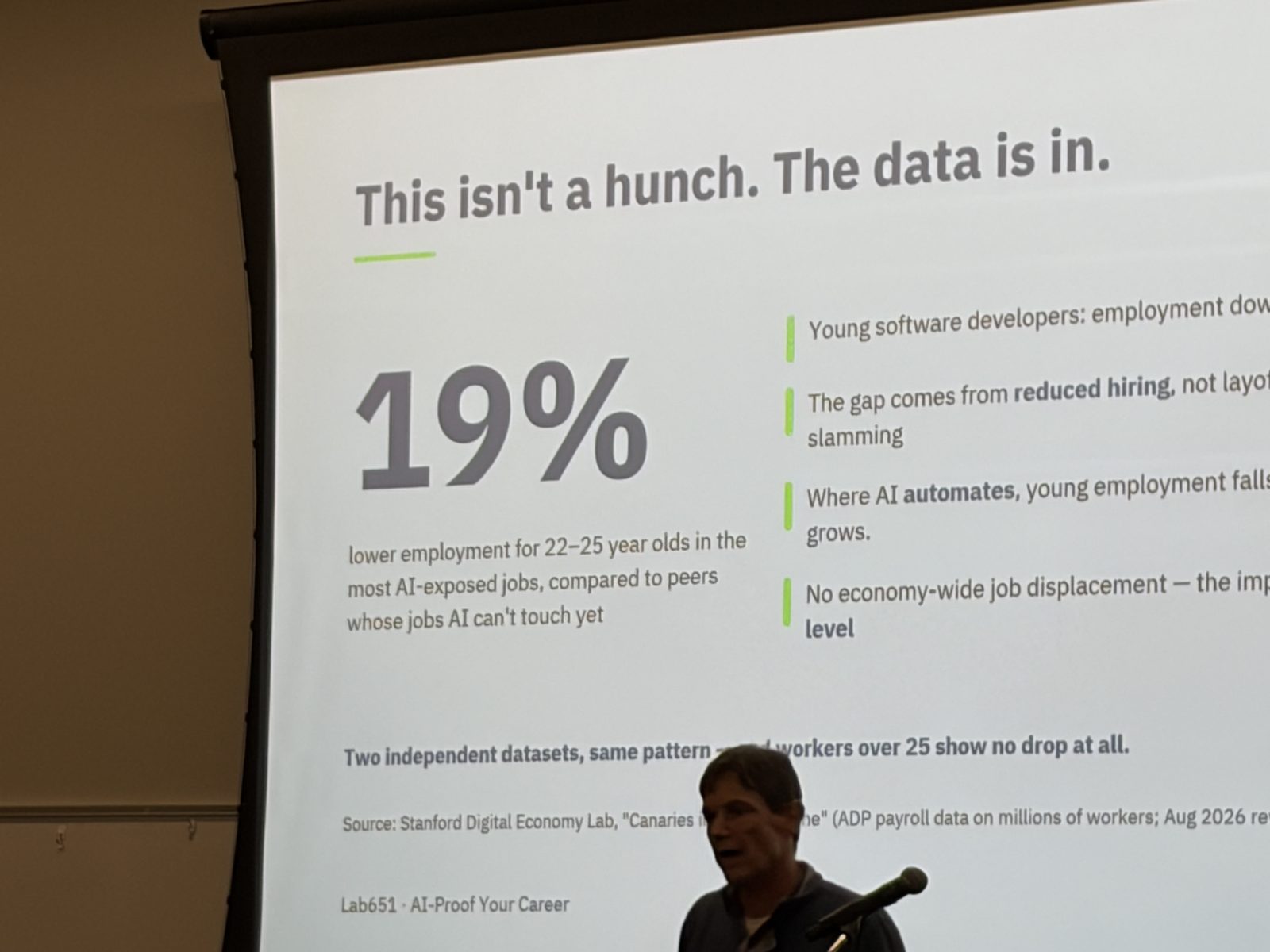
The data backs this up. Stanford’s Digital Economy Lab, working from ADP payroll data, found 19% lower employment for 22 to 25 year olds in the most AI-exposed jobs compared to peers in jobs AI can’t touch yet. Workers over 25 show no drop. The gap comes from reduced hiring, not layoffs: the door is narrowing, not slamming. And where AI augments people instead of automating their tasks, young employment holds or grows.
The market is splitting into two tracks
PwC’s 2026 AI Jobs Barometer, built on more than a billion job postings, shows the other side of that story. Postings asking for AI skills grew 69% in a year while everything else grew 9%. AI skills carry a 62% average wage premium. The most AI-capable companies grew headcount 52%, against 36% at the least capable. AI adopters are hiring more, not less.
The stat I slowed down on: AI-exposed entry-level roles are now seven times more likely to demand what used to be senior skills, such as judgment, leadership and client contact. One track is professionalized, where AI amplifies you and pay rises. The other is commoditized, where AI replaces you and pay falls. Nobody assigns you a track.
It’s also early. Anthropic’s labor market research compared what AI could already do in each occupation with what people are actually using it for. In software and technical work, it’s 94% possible and 33% happening. “Nothing’s happened to my job yet” is true for a lot of people. It means the window to get ahead of it is still open.
Here’s your opening
The Microsoft and LinkedIn Work Trend Index found that 71% of leaders would pick a less experienced candidate with AI skills over a more experienced one without them. Experience used to be the moat. AI skills breached it, and you can build them faster than anyone can build 20 years of experience.
That isn’t reckless on the employer’s part. Companies already have experience in their senior people. What their teams lack is AI fluency. The junior who brings it isn’t expected to replace a veteran. They’re expected to make the veterans faster.
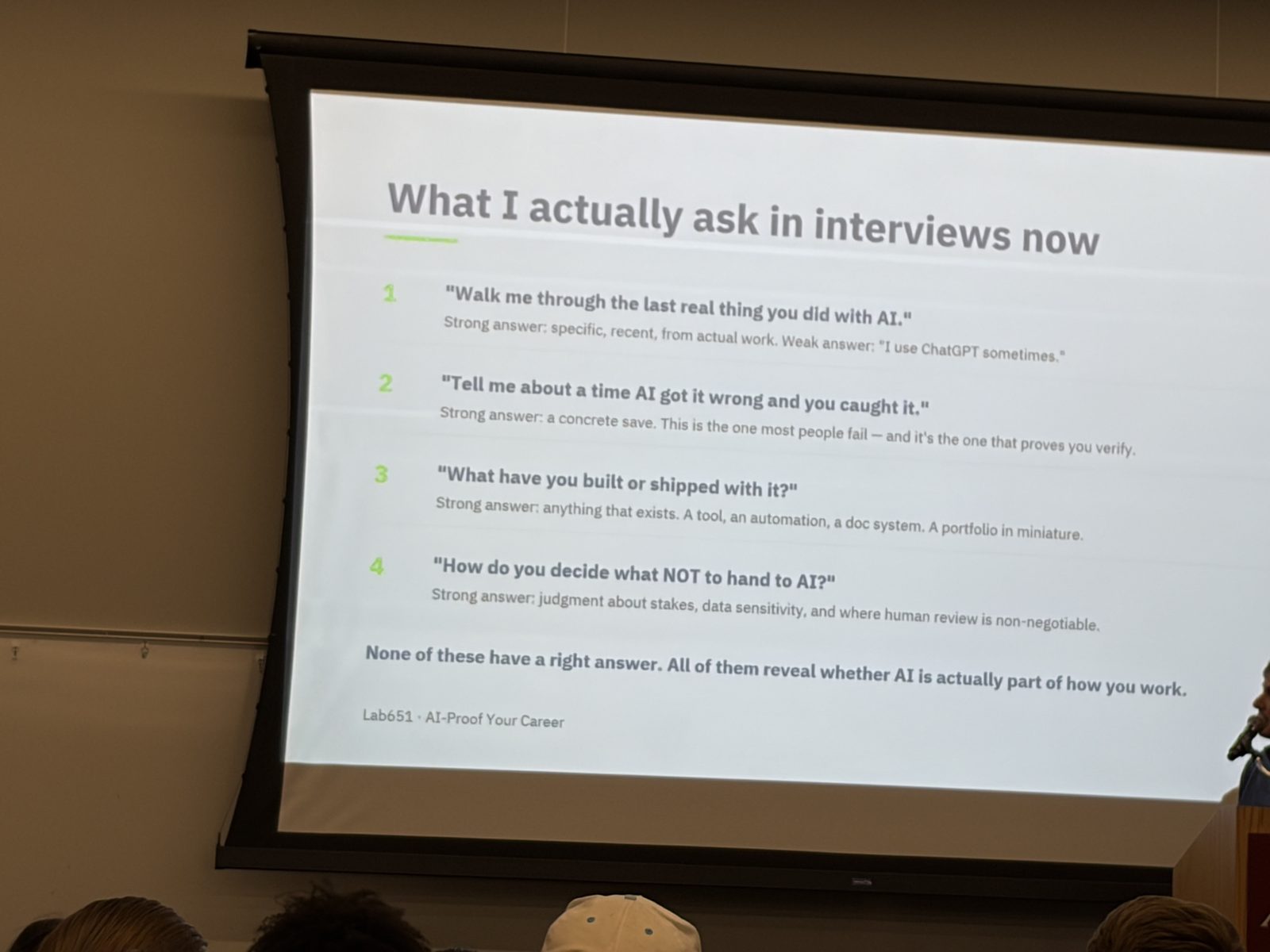
These are the questions I now ask in interviews. Steal them, and prepare answers before your next one:
- “Walk me through the last real thing you did with AI.” Specific and recent beats “I use ChatGPT sometimes.”
- “Tell me about a time AI got it wrong and you caught it.” The one most people fail, and the one that proves you verify.
- “What have you built or shipped with it?” Anything that exists. A portfolio in miniature.
- “How do you decide what not to hand to AI?” Judgment about stakes, data sensitivity and where human review is non-negotiable.
None of them has a right answer. All of them reveal whether AI is actually part of how you work.
What AI can’t replace
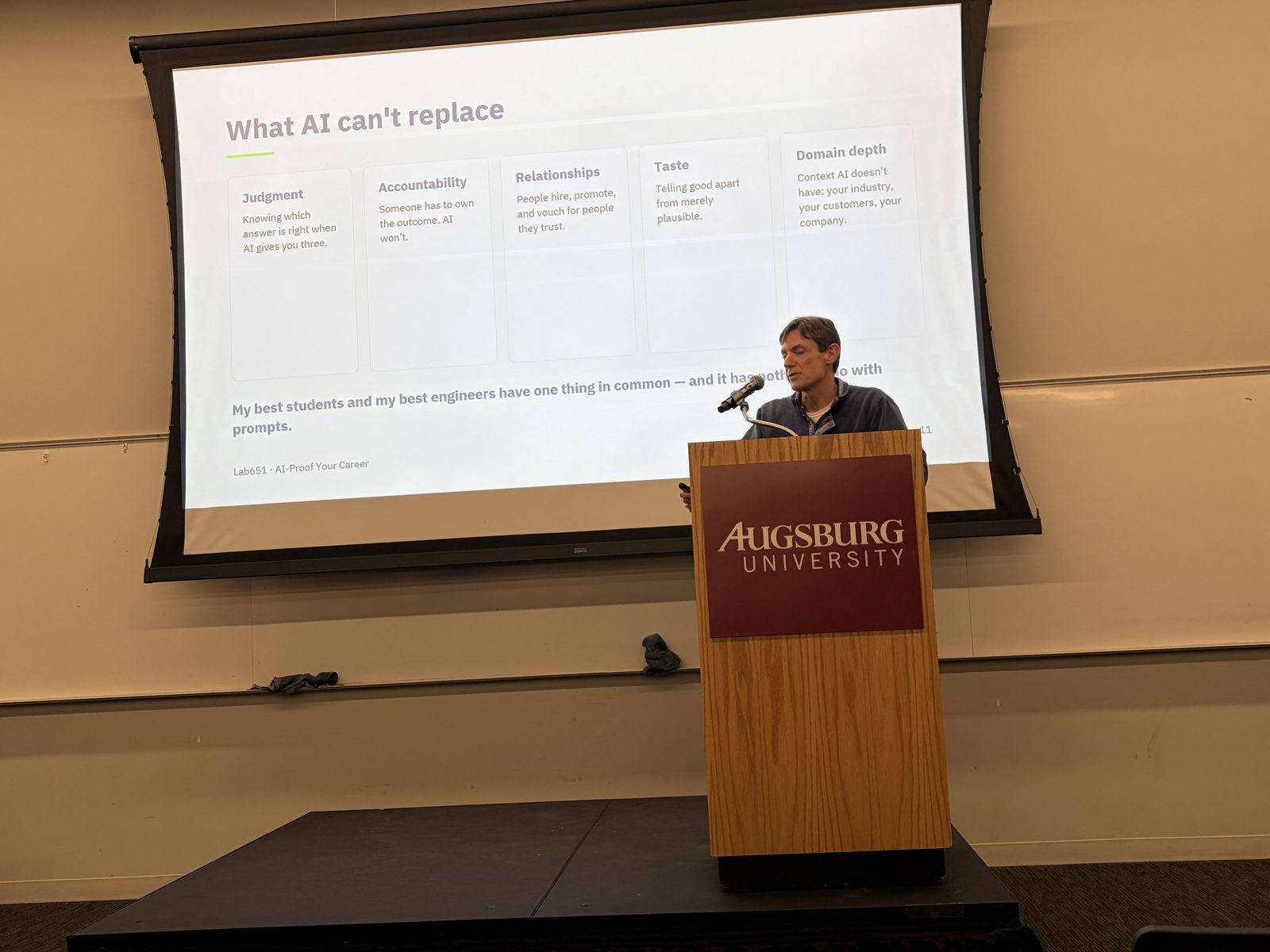
In the regulated industries we serve, the code is cheap now. Knowing what’s safe to ship is what clients pay for, and it’s what I hire for. Every field has its own version of “getting it right isn’t optional.” Five things concentrate there:
- Judgment: knowing which answer is right when AI gives you three.
- Accountability: someone has to own the outcome. AI won’t.
- Relationships: people hire, promote and vouch for people they trust.
- Taste: telling good apart from merely plausible.
- Domain depth: your industry, your customers and your company, context AI doesn’t have.
The obvious question came next: if AI took the grunt work, where does experience come from? The honest answer is that the old pipeline is breaking. But experience was never the typing. It was reps of judgment. Review 50 AI drafts a week and ask a senior why one got overridden, and you get more reps in a year than hand-writing five. Use AI as a tireless tutor on your industry. Then volunteer for the client call, the on-call and the post-mortem, because nobody automates those reps. The ladder’s bottom rungs are gone. The way up didn’t disappear. It changed.
The human in the loop is the deliverable
I shared a story from our own work. We built an AI system for an insurance client that reads and assesses incoming claims and policy documents, work that used to mean hours of manual review. The client never asked us to replace their adjusters and underwriters. The people still handle the workload and make every decision. What they get from the AI is a prioritized list of what to focus on first. Nobody got automated out. The experts got a sharper queue.
The loop runs the other way at Lab651, too. Our clients keep humans in the loop to judge. We keep humans in the loop to steer. AI writes more of our code every month, and the human work has moved up, not out: understanding the why behind every feature, steering a product as the market moves, and carrying the client relationship. We call that product-minded engineering, and it’s the discipline built into every sprint of the Lab651 Proven Project Process™. The same idea works in any field: a product-minded accountant, marketer, nurse or analyst is the one AI makes more valuable.
What to do this month
Using AI well is no longer a specialty. It’s the job. AI is also moving from assisting with work to doing it, from “you ask, it assists” to “you assign, it executes.” That makes everyone’s next skill a management skill: specify, delegate, review.
My advice was to stop collecting tools. Pick one assistant, pay for it, and climb one level a week:
- Week 1, ask it questions. Ask it everything, daily. Build the reflex before the skill.
- Week 2, draft everything with it. Every email, report and analysis starts with AI and ends with your judgment.
- Week 3, delegate a project. Hand it an outcome, not a task. Review what comes back, redirect, ship it.
- Week 4, build something that runs without you. I have one that turns raw meeting notes into a finished client proposal in our company template, and another that checks our payroll run and gives me an approve-or-hold answer. Build one, then show your team.
Check your company’s AI policy before moving work data up those levels. Being the person who knows the policy is a career move of its own. One speed hack: use the mic button on your keyboard. Talk your rough thoughts out and let AI clean them up. It’s how half my drafts start now.
Then make the moves that compound. Become your team’s AI integrator. Show a portfolio, not just a resume. Go deep in one industry, because depth plus AI is defensible and generic skills plus AI are a commodity. Network in person, since relationships are the one network AI can’t crawl.
And start something. In 2019 I started a community group, Applied AI, because I was curious about applied AI. It became a podcast, a newsletter, meetups and a conference. Today AI cleans our podcast audio, drafts our newsletter and builds our websites. AI collapsed the cost of starting, and the gap between an idea and a real thing has never been smaller.
The advantage is you
That was the closing line, and I meant it. The five things AI can’t replace are the “you” part, and everything AI does well makes them scarcer and more valuable.
Thank you to Augsburg University for the invitation, and to the students who stayed after with great questions. The slides are on GitHub if you want to share them. If this gets you to start something, email me and tell me about it. I answer those. The Applied AI meetups run monthly in Minnesota, with some events free, and the Conversations on Applied AI podcast is wherever you get podcasts. To keep up with all of it, sign up for the monthly Applied AI newsletter.
If you lead a team that’s bringing AI into regulated work and you want the judgment seat designed in from the start, let’s talk. And if you’re an engineer who already works this way, we’re hiring.
Sources
- Stanford Digital Economy Lab, “Canaries in the Coal Mine,” ADP payroll data, August 2026 revision
- PwC, 2026 Global AI Jobs Barometer, June 2026
- Anthropic, “Labor market impacts of AI: A new measure and early evidence,” March 2026
- Microsoft and LinkedIn, Work Trend Index